Atlanta Dropped Its Limit on Airbnb Hosts. Here's Who Actually Owns the Listings
Earlier this week Atlanta City Council voted 9–5 to cut nine words from the city’s 2021 short-term rental ordinance, WABE reported. Those words limited hosts to their primary residence plus one additional property.
The city never enforced that limit. After a federal appeals court struck down a similar residency rule in New Orleans in 2022, officials worried it wouldn’t survive a challenge, so the rest of the law sat unenforced too. Council member Matt Westmoreland, who proposed the change, says removing it lets the Planning Department enforce everything else starting in January: licenses, noise and occupancy rules, and penalties or license revocation for hosts who break them.
The council members who voted no had a different worry. Removing the limit, they argued, opens the door to investors running as many units as they want. Kelsea Bond proposed a two-unit cap instead, and the council rejected it.
So the debate comes down to a few questions we can answer with data. How many Atlanta hosts run more than two active listings? How many active listings have a license today? And where are they?
Atlanta · September 2026
- 6,134 active listings
- 38.2% run by hosts with 3 or more listings
- None of the listings set a license or registration number on Airbnb
Who owns Atlanta’s listings
| Listings per host | Hosts | Listings | Share of listings |
|---|---|---|---|
| 1 | 3,071 | 3,071 | 50.1% |
| 2 | 360 | 720 | 11.7% |
| 3–9 | 280 | 1,167 | 19.0% |
| 10+ | 56 | 1,176 | 19.2% |
Hosts with one or two listings are 91.1% of hosts but only 61.8% of listings. The 56 hosts with 10 or more listings run 19.2% of the market on their own.
That’s the number behind the vote. The old rule, if it had ever been enforced, would have left each host with at most two units. Bond’s cap would have done the same. 2,343 listings (38.2%) belong to hosts over that line. Under the amended law, none of them are breaking a limit.
Not a single listing shows a license
The 2021 ordinance already requires a city license. 0 of 6,134 active listings displayed a license number in September 2026.
That gap is what January is really about. Westmoreland’s point is that the rules on the books were never enforced. If the Planning Department starts with licensing, every one of those 6,134 listings is out of compliance on day one.
Where the listings are
| Neighborhood | Listings | Change since March | Share run by 3+ listing hosts |
|---|---|---|---|
| Downtown | 872 | +56 (+6.9%) | 72.4% |
| Midtown | 495 | +53 (+12.0%) | 56.4% |
| Home Park | 72 | −7 (−8.9%) | 48.6% |
| North Buckhead | 88 | −6 (−6.4%) | 33.0% |
| Old Fourth Ward | 300 | +2 (+0.7%) | 49.3% |
| Castleberry Hill | 156 | +45 (+40.5%) | 35.9% |
| Marietta Street Artery | 119 | +32 (+36.8%) | 21.8% |
Three places came up in the council debate. Downtown is home to the Landmark, the high-rise residents described to the council as unsafe because of illegal short-term rentals. Downtown has 872 active listings, and 72% of them are run by hosts with three or more listings, almost double the city average of 38%.
Home Park is the more telling case. The council banned short-term rentals there in August 2025. A year later the neighborhood still had 72 active listings, down only slightly from 79 in March, and they were booked about 53% of their available nights, slightly above the city average of 50.9%. The ban is on the books, but the listings are still up and still taking guests. As Westmoreland put it to WABE, “an ordinance is only as good as its enforcement.”
North Buckhead tried to get its own ban a few months after Home Park and the council said no. It has 88 active listings.
Active supply rose, then leveled off
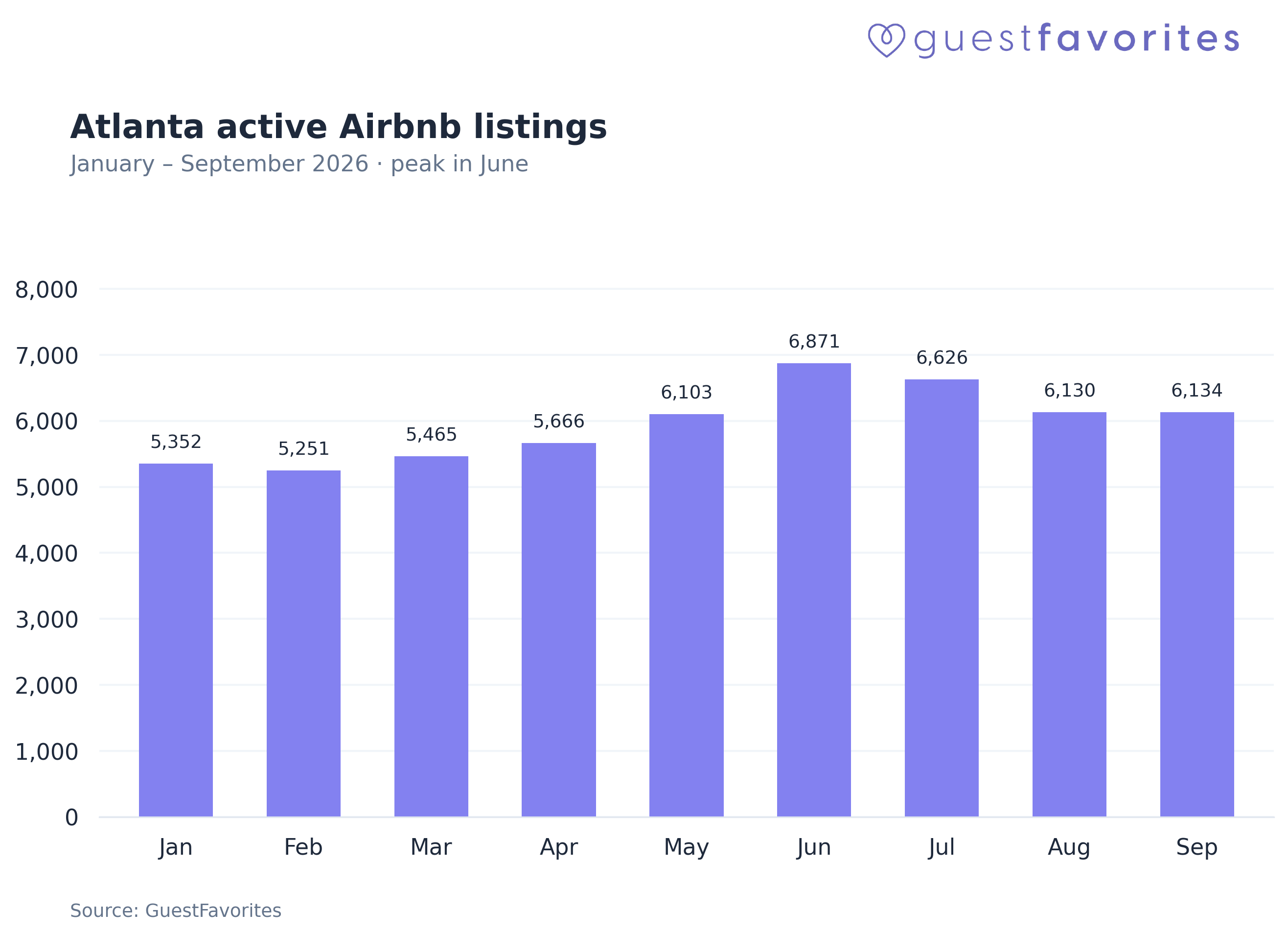
Active listings in the city climbed from 5,465 in March to a June peak of 6,871, then eased to 6,130 in August and 6,134 in September. That’s up 12.2% from March.
That net number hides a lot of turnover. Between March and September, 2,011 listings came onto the market, some brand new and some coming back after a break, while 1,342 that were active in March went offline. Of the 2,011 that came on, 522 (26.0%) are run by hosts with three or more listings. The other 1,489 (74.0%) belong to hosts with one or two.
Demand didn’t keep up
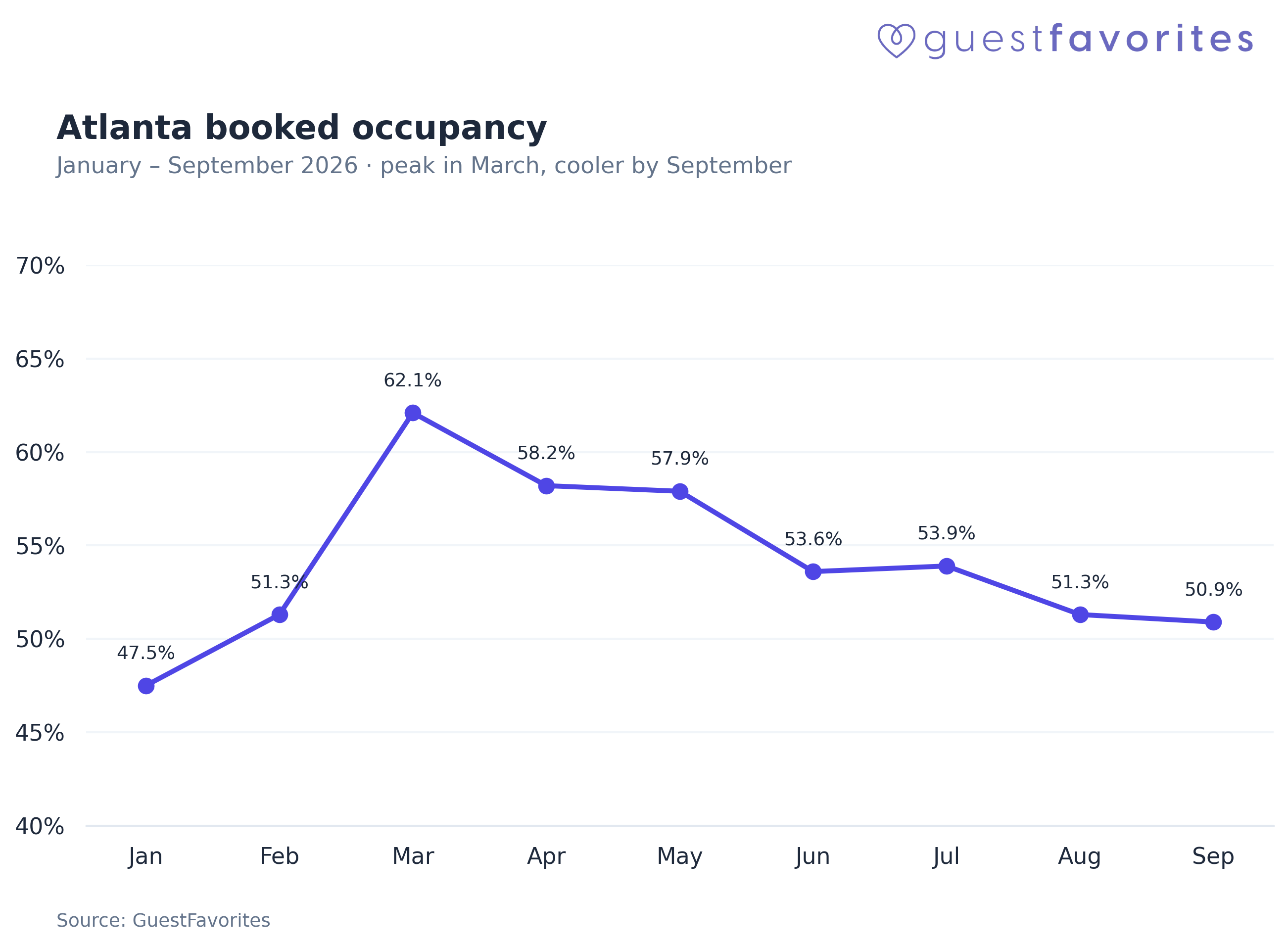
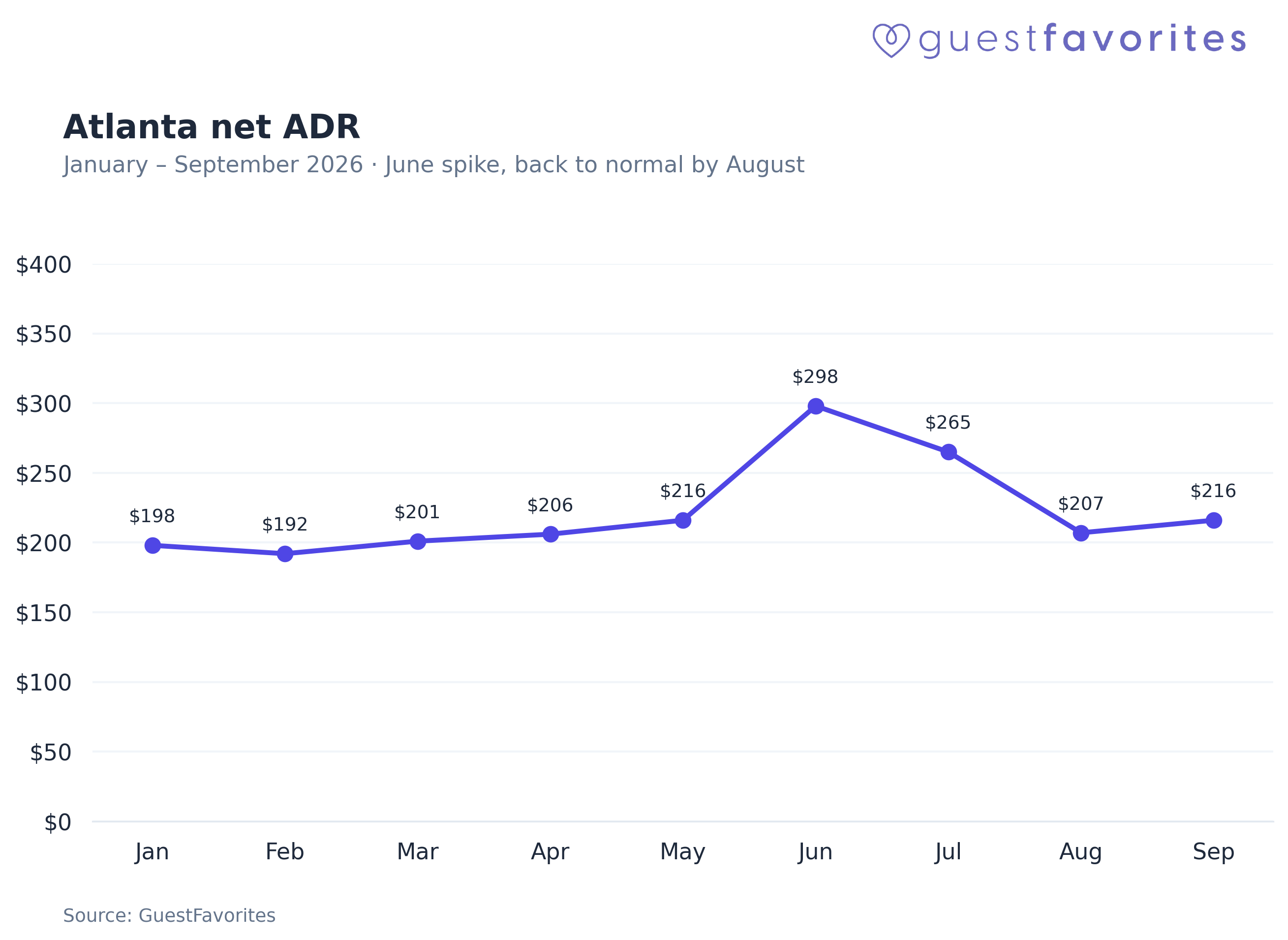
More active listings on the market, fewer nights booked per listing. Occupancy peaked at 62.1% in March and was down to 50.9% by September. The nightly rate jumped to $298 in June, most likely because of the World Cup matches at Mercedes-Benz Stadium, and was back to $216 in September.
| Month | Active listings | Booked occupancy | Net ADR |
|---|---|---|---|
| Jan 2026 | 5,352 | 47.5% | $198 |
| Feb 2026 | 5,251 | 51.3% | $192 |
| Mar 2026 | 5,465 | 62.1% | $201 |
| Apr 2026 | 5,666 | 58.2% | $206 |
| May 2026 | 6,103 | 57.9% | $216 |
| Jun 2026 | 6,871 | 53.6% | $298 |
| Jul 2026 | 6,626 | 53.9% | $265 |
| Aug 2026 | 6,130 | 51.3% | $207 |
| Sep 2026 | 6,134 | 50.9% | $216 |
Atlanta, Georgia. Active listings = nights with availability in the month. Occupancy rounded to one decimal, net ADR to the nearest dollar. Source: GuestFavorites.
What changes for hosts in January
- You’ll need a license. It’s been required since 2021. The difference is that the city now says it will check.
- Noise and occupancy rules can cost you the license. The ordinance allows penalties and revocation for violations, and that’s the part council members tied to party houses and the Landmark.
- There’s no cap on units, for now. Bond and Liliana Bakhtiari both said they want one, and several council members argued for broader rules later. If you run several units, plan for this to come back.
- Some neighborhoods can still say no. Home Park already banned short-term rentals, and 72 listings are still active there. Once the Planning Department starts enforcing, those are the easiest ones to find. Expect more neighborhood fights rather than one citywide rule.
- Budget for a slower market. Late summer ran at about 51% occupancy and $216 a night, and enforcement starts in January, when last year’s numbers were 47.5% and $198.
How we measured it
All figures come from GuestFavorites market data for the city of Atlanta, Georgia, through September 2026. Active listings are short-term rentals with at least one night available in the month. We grouped September’s active listings by Airbnb host to count listings per host, and counted a listing as licensed when it displays a registration or license number. Booked occupancy is the share of available nights that were booked. Net ADR is the average nightly rate in US dollars on booked nights.
FAQ
What did Atlanta City Council change in its short-term rental ordinance?
In a 9–5 vote, the council removed the words that limited hosts to their primary residence plus one additional property. WABE has the full story. The rest of the 2021 ordinance stays, and the city can start enforcing it in January 2027.
Is there a limit on how many Airbnbs you can own in Atlanta?
Not anymore. The primary-residence-plus-one limit is gone, and the council rejected a two-unit cap. You still need a city license and have to follow noise and occupancy rules.
How many Atlanta Airbnb hosts have more than two listings?
336 hosts, controlling 38.2% of active listings in September 2026.
How many Atlanta Airbnbs have a license?
0 of 6,134 active listings (0%) showed a license number in September 2026.
How many Airbnb listings are there in Atlanta?
We counted 6,134 active listings in September 2026, up from 5,465 active listings in March.
Atlanta occupancy and rates on GuestFavorites
GuestFavorites tracks booked occupancy, net ADR and active listings for Atlanta.
You can also compare other US markets on Airbnb occupancy rates by city in the United States, or look up your own market on GuestFavorites.
About the author

Gabriel Schammah
Gabriel Schammah is the founder and CEO of GuestFavorites, a platform that helps vacation rental owners and managers optimize revenue with Airbnb market data.
Get GuestFavorites updates
Notes on Airbnb markets, regulation, and revenue for hosts and managers.
Related posts

Best UK Holiday Let Markets by Occupancy Rate in 2026
A data-backed ranking of UK holiday let markets by occupancy rate, ADR, annual revenue and active Airbnb listings, using GuestFavorites market data from May 2025 to April 2026.

Airbnb Arbitrage in Australia 2026: Market Analysis and Strategies
Discover how Airbnb rental arbitrage works in Australia, analyze market opportunities across major cities, and learn the strategies to build a profitable rent-to-rent Airbnb business in 2026.