Worst Airbnb Reviews of 2026: The Weirdest Guest Stories

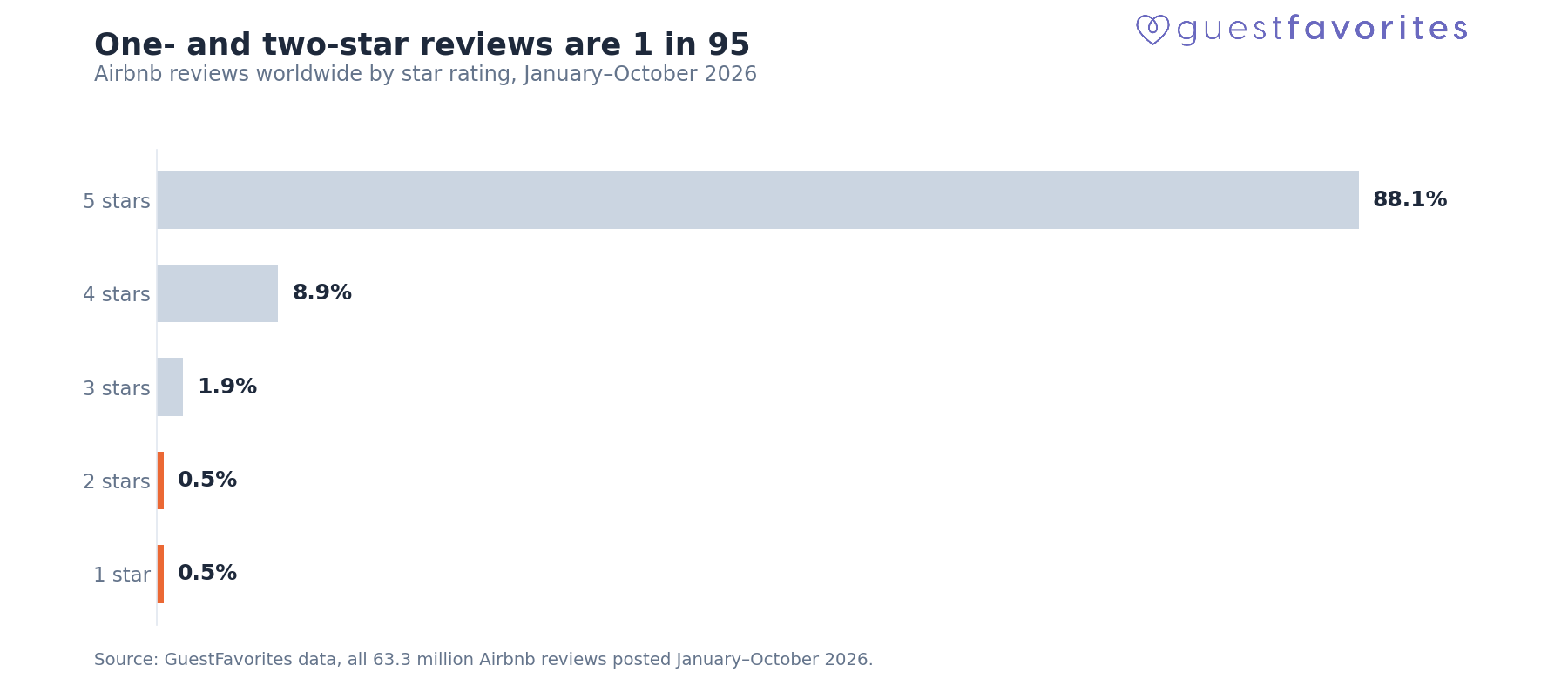
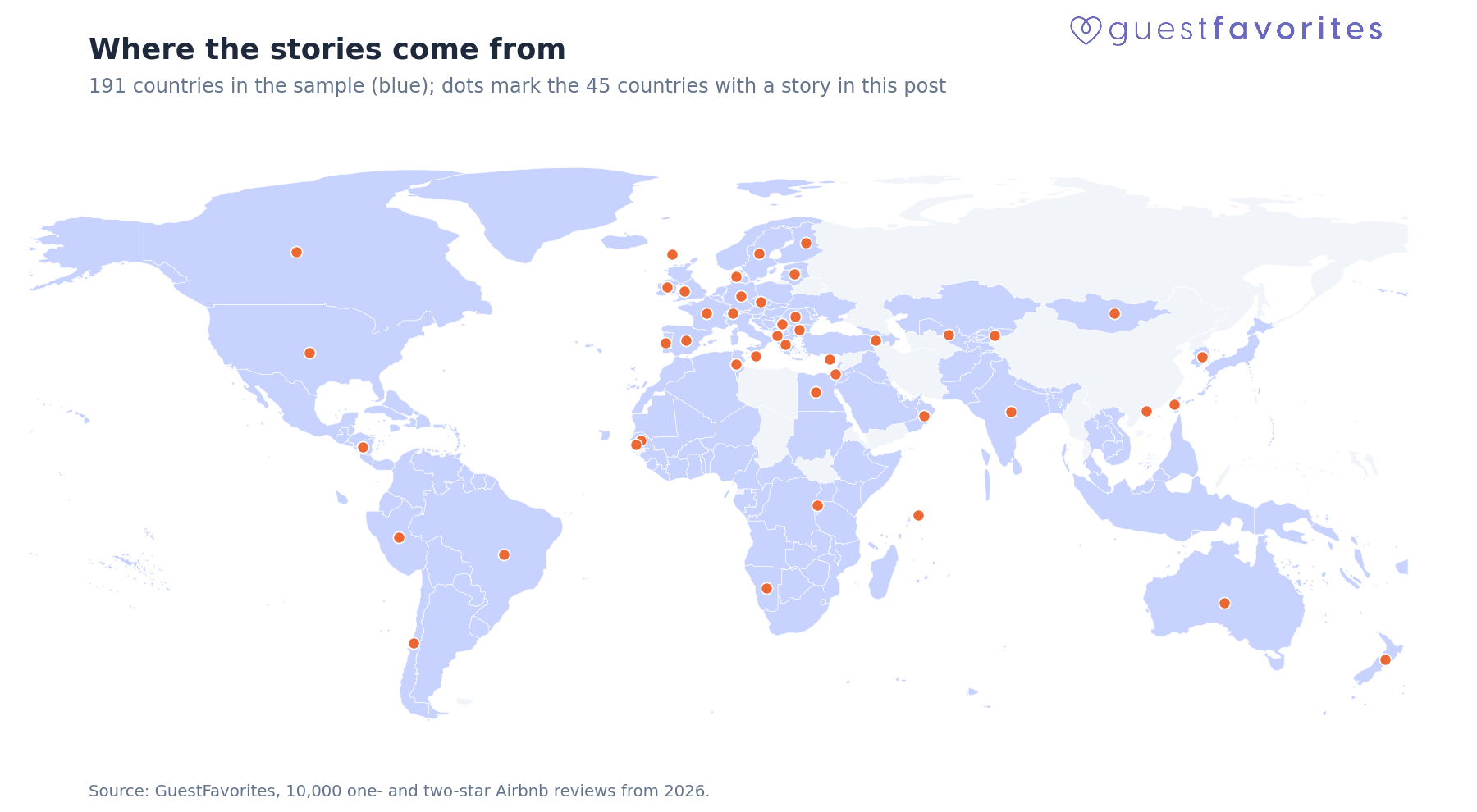
Only 1 Airbnb review in 95 gives one or two stars. Of the 63.3 million reviews posted worldwide from January to October 2026, in GuestFavorites data, 88% were five stars and 1.05% were one or two. We read 10,000 of those bad reviews from 2026, from 191 countries and 43 languages, with extra weight on the countries most lists forget. Most say what you’d expect: the place wasn’t clean, something was broken, the photos were generous. And then there are the donkeys in Oman.
Here are the strangest stories, retold without names: the joke is the situation, not the guest or the host.
Key findings
- About a quarter of bad reviews are about dirt found on arrival (24%), and almost one in five about something broken (18%).
- The listing that wasn’t is the third complaint (13%): wrong village, wrong view, and in a few cases no house at all.
- Fewer than 1% of bad reviews were mainly about house rules or chores.
- One star is about the host, two stars about the house. The host is the main complaint in 17% of one-star reviews and 7% of two-star ones.
- Bad reviews are ten times more common in the Gulf than in the Nordics: 3.6% of reviews in the United Arab Emirates are one or two stars, against 0.37% in Finland.
- Hosts answering through chatbots, and photos made with AI, both turn up in guests’ complaints in 2026.
The house that wasn’t there
- Rwanda: the pin led to an empty plot. The apartment, the guest writes, is not real, and the host stops answering once you reach the empty space.
- The Gambia: no house at the pinned spot near the beach. It was in another village, 30 minutes away by car. The “jacuzzi” was a bathtub, and the pool did not exist.
- Namibia: the house was for sale and the host was gone. The listing was still open for booking.
- Kyrgyzstan: after three hours driving around looking for a hostel with no pin on any map, the guest learned it had been shut down two years earlier.
- Canada: the rental was a driveway of grass and stones. Locals passing by said it was a known way to fool people. The host offered 15% off.
- Macau: the room was in mainland China. The guest found out at check-in and had to cross the border to reach it.
- France: a family booked four bedrooms and four bathrooms, and found nine bedrooms and two bathrooms.
- Uzbekistan: the flat didn’t match the photos. The host explained that the decor had been brought in only for the photo shoot.
The view was not as described
- Romania: a mountain view, on the listing. A cemetery, out of the window.
- Spain: “five minutes from the beach” was twenty, and the house looked out over a prison.
- Czech Republic: the lake view was a puddle you couldn’t see from the house, with two goldfish in it.
- Bulgaria: the bedroom window in the photos was fake. So was the sunlight: a lamp behind it imitated daylight.
- Denmark: a “barrel house” in the car park of a petting zoo.
- Albania: a sheep pen a few metres from the door, with the smell and the flies. The host argued the sheep were a positive.

The Czech “lake view”: a puddle with two goldfish in it. Illustrative photo, not the listing.

In Bulgaria, the window was fake and the sunlight was a lamp. Illustrative photo, not the listing.
Wildlife included
- Oman: the guests left their eggs and yogurt on the porch table overnight. At dawn, donkeys ate them, then opened the garbage bags. The guest called it curious and hilarious, but not practical.
- Tunisia: the pool closed at 5 p.m. and was shared with the host’s dogs, who swam with the guests, drank the pool water, bit their flip-flops and ate their clothes.
- Nicaragua: a humming noise all night. The bed base was hollow bamboo, and wasps were nesting inside it.
- Israel: a mouse in the bedroom and droppings on the bed. The host offered a Swedish massage with hot stones, then said the droppings came from a butterfly.
- United States: ants came out of the electrics whenever the stove was on. The manager offered another house, but warned it had ants too.
- Portugal: the cockroaches multiplied every day, and the owner explained they were “part of the environment”.

In Oman, donkeys ate the breakfast the guests had left on the porch. Illustrative photo, not the listing.
Engineering marvels
- Australia: the cabin’s long-drop toilet stands in the middle of the room, between the beds and the kitchen, with no walls around it.
- Ireland: the shower only works if you also turn on the bathroom sink. The host came over to demonstrate.
- Cyprus: taking the key card out of its slot also cut the fridge, so a day’s groceries spoiled.
- Malta: “fully air-conditioned”, through a meter that takes euro coins, in a 43-degree heat wave. In another Maltese flat, the host refused to top up the meter and asked whether the guest’s mother had “drunk the AC”.
- Finland: a floating igloo, over 30 degrees inside, rocking in the waves. The guests lasted 30 minutes.
- Sweden: the front door was a shop window. Inside, a microwave stood in a shower cubicle.
- Israel: a barking dog kept a guest awake all night. The noise was coming from the bathroom.
- Taiwan: the air conditioning smelled like stinky tofu from the night market.
- Peru: a rotisserie chicken restaurant next door vented its smoke into every flat in the building, from about 10 a.m. to 10 p.m.
- Serbia: the bed shook, by the guest’s estimate, like a magnitude 4.5 to 5 earthquake.

Most long drops have walls. The one in the Australian cabin did not. Illustrative photo, not the listing.

In Finland, the floating igloo rocked in the waves and passed 30 degrees inside. Illustrative photo, not the listing.
House rules and small mercies
- Brazil: to use the pool, guests needed a medical certificate issued within the last 60 days. They found out on arrival.
- Switzerland: the balcony door, the kitchen cabinets and the fridge were all locked.
- New Zealand: with no kitchen, the host set up a hob, a pot and a table in the garage. Before checkout he asked the guest not to cook the last dinner or breakfast, so the smell wouldn’t bother the next guests, and recommended a restaurant.
- Latvia: five hours before check-in, a message: bring dark swimsuits, because the jacuzzi water comes from a well and is brown.
- Denmark: a very sensitive sound system above the dining table brought eight guests repeated warnings during ordinary dinner conversation.
- Sweden: to fix the internet, press a tiny hole with a needle. Asked whether there was a needle in the house, the hosts laughed.
- South Korea: if you’re tall, the co-host suggested, use the downstairs bathroom.
- Chile: the “courtesy” shampoo was half a bottle of baby shampoo that expired in 2023.
- United States: fifteen laminated signs, two dishwasher pods (one reserved for the last night) and two laundry pods (one reserved for the beach towels).
Hosts who were a little too present
- Canada: the owner lived in the basement and held a fire drill at 6:15 on a Sunday morning, running up the stairs with a ladder while the guests slept.
- Armenia: the host blamed a blocked shower drain on the guest’s hair. The guest is bald.
- India: at 11:00 sharp the staff rang a bell for checkout and shut off the toilet’s water at the same minute.
- Greece: at 11:02 on checkout day, a cleaner with a bucket and a mop knocked and waited while the guest got dressed.
- France: an inventory that counted the cutlery piece by piece, and a host who came at 6:40 a.m. to watch the guests load the car.
- United States: the host answered only through AI agents. The guest had to get the bot to admit it was an AI before a human replied.
The bill
- Uzbekistan: €52 after checkout, for a pencil and stains on a towel and a bath mat.
- Germany: one cooking stain led to a claim of about €1,440, including a new oven, a “night key service” and “energy waste”.
- Faroe Islands: a 250-krone “management fee” for helping the guests pay a 160-krone tourist fee.
- Australia: locked out, the guests agreed to a $100 call-out fee for the spare key. The host drove over and found he had lost it.
- Senegal: stuck in a bathroom with a faulty door for over an hour, a guest was asked to pay a fee to be let out.
- Egypt: the host arrived with the refund in his pocket and wouldn’t hand it over until the guest had left a review.
Getting there
- Seychelles: the house sat at the top of a 1.4-kilometre road climbing 200 metres, with stretches steeper than 20%. The owner forbids riding bikes down it, so the guests pushed them up.
- Mongolia: strong winds cancelled a planned ger stay. The guest was taken instead to the host’s sister’s flat behind her drugstore, with no bed, and spent half the day sitting in a corner of the shop.
- Wales: locked out overnight with no answer from the hosts, the guests got back in by borrowing a six-metre ladder from scaffolders down the road.
- Ireland: the key was at the front desk of a sports-betting casino a few blocks away.
What 10,000 bad reviews are actually about
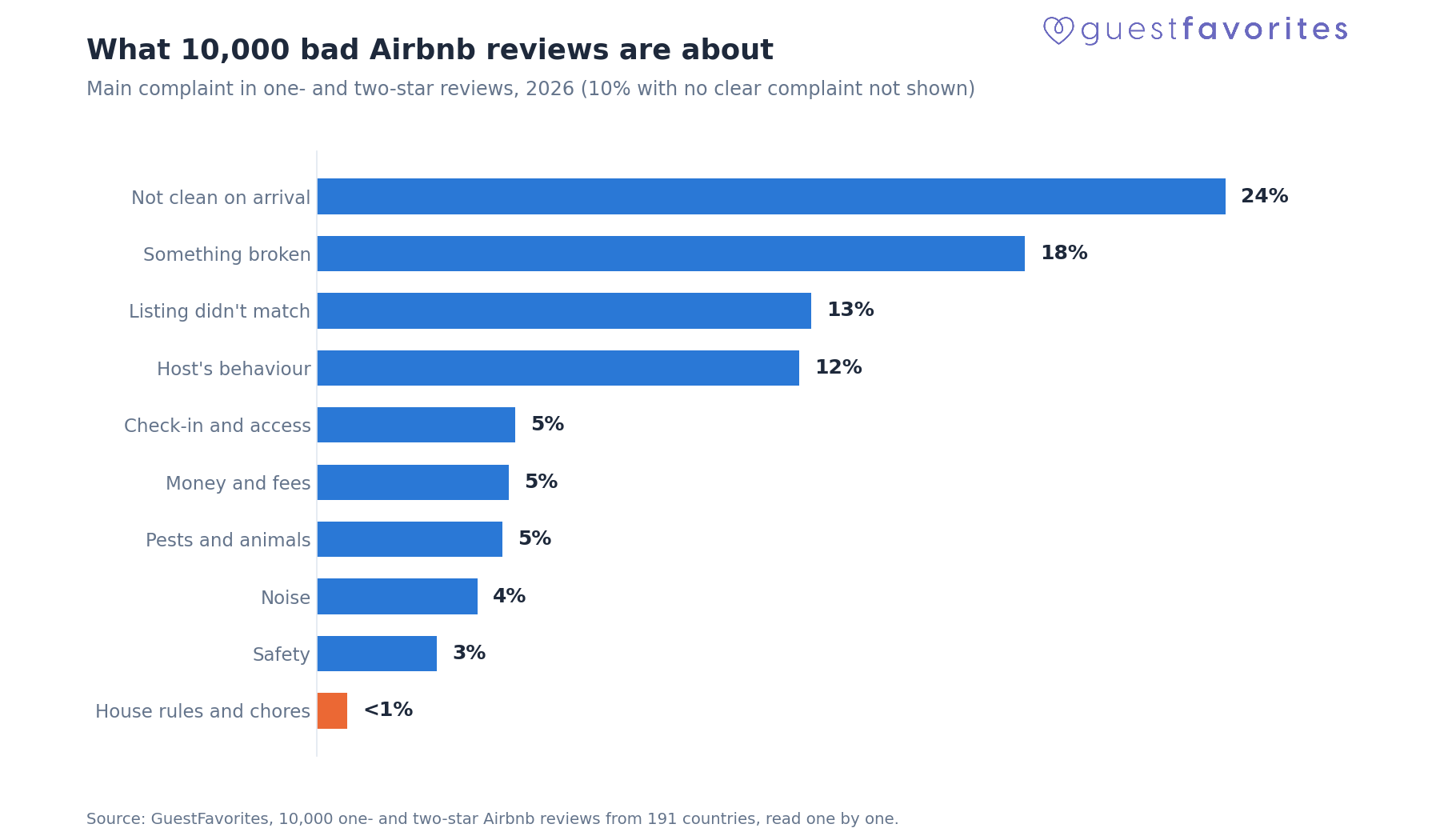
| Main complaint | Share of bad reviews |
|---|---|
| Not clean on arrival | 24% |
| Something broken | 18% |
| The listing didn’t match the stay | 13% |
| The host’s behaviour or communication | 13% |
| Check-in and access | 5% |
| Money and fees | 5% |
| Pests and animals | 5% |
| Noise | 4% |
| Safety | 3% |
| House rules and chores | 1% |
| Other, or no clear complaint | 10% |
10,000 one- and two-star Airbnb reviews posted January–October 2026, 191 countries. Each review counted once, under its main complaint. Source: GuestFavorites.
Behind the stories, the pattern is plain. Guests forgive a lot, but not a dirty home at check-in: it is the first complaint overall, and in all but one of the batches we read. The listing that oversells comes next, from a lamp posing as a window to a pin on an empty plot. And a host who is hard to reach turns a small problem into one star.
The star rating says something too. One-star reviews are more often about a person: the host is the main complaint in 17% of them, against 7% of two-star reviews. Two stars are about the house: something broken is the main complaint in 23% of them, dirt in 27%.
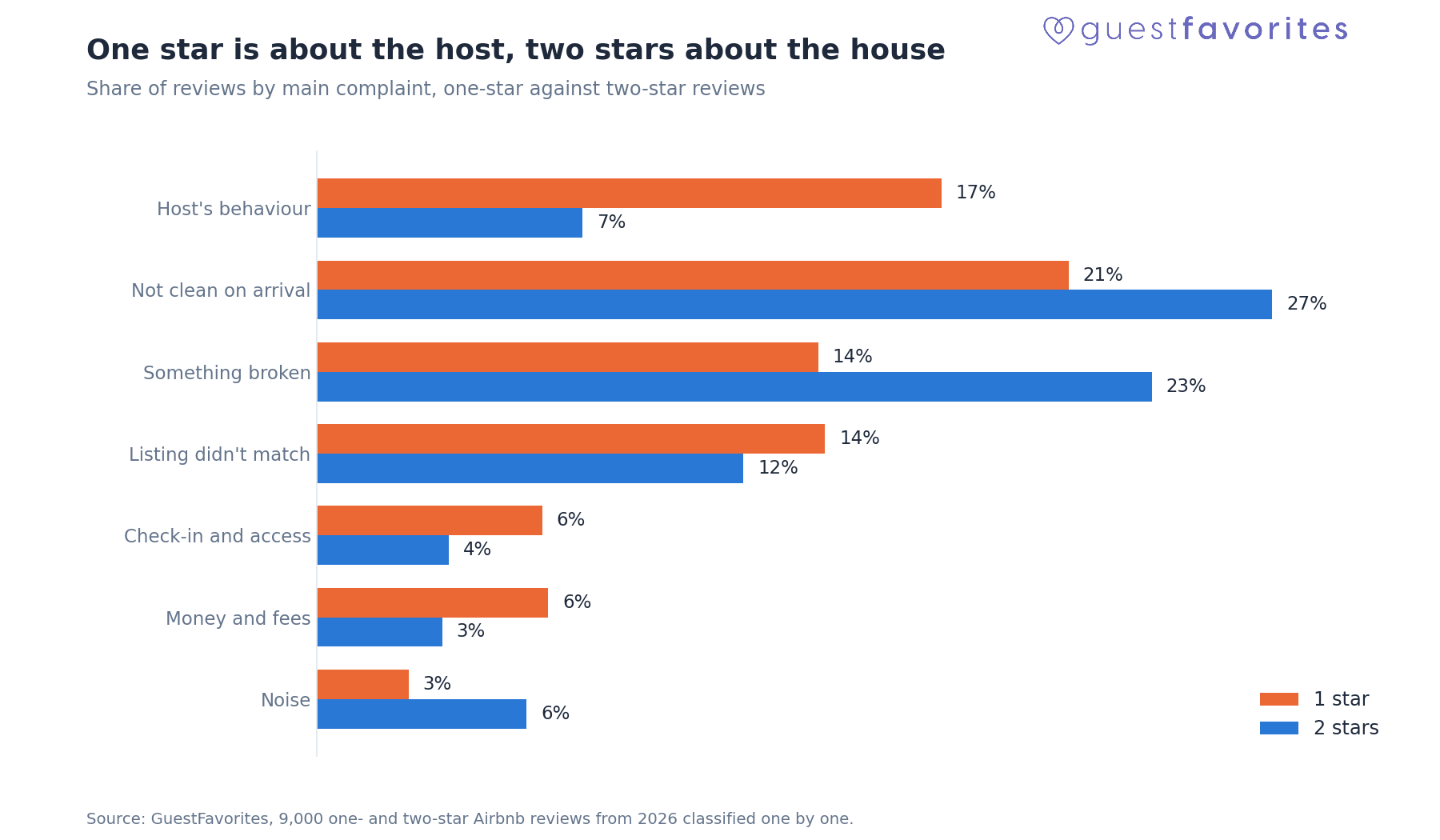
9,000 one- and two-star reviews from 2026, each classified under one main complaint. Source: GuestFavorites.
Regions complain about different things. In Europe, a dirty home is the main complaint in almost a third of bad reviews (32%). In Latin America and Sub-Saharan Africa, something broken comes first (23% and 21%), and the host’s behaviour weighs most in Sub-Saharan Africa (16%).
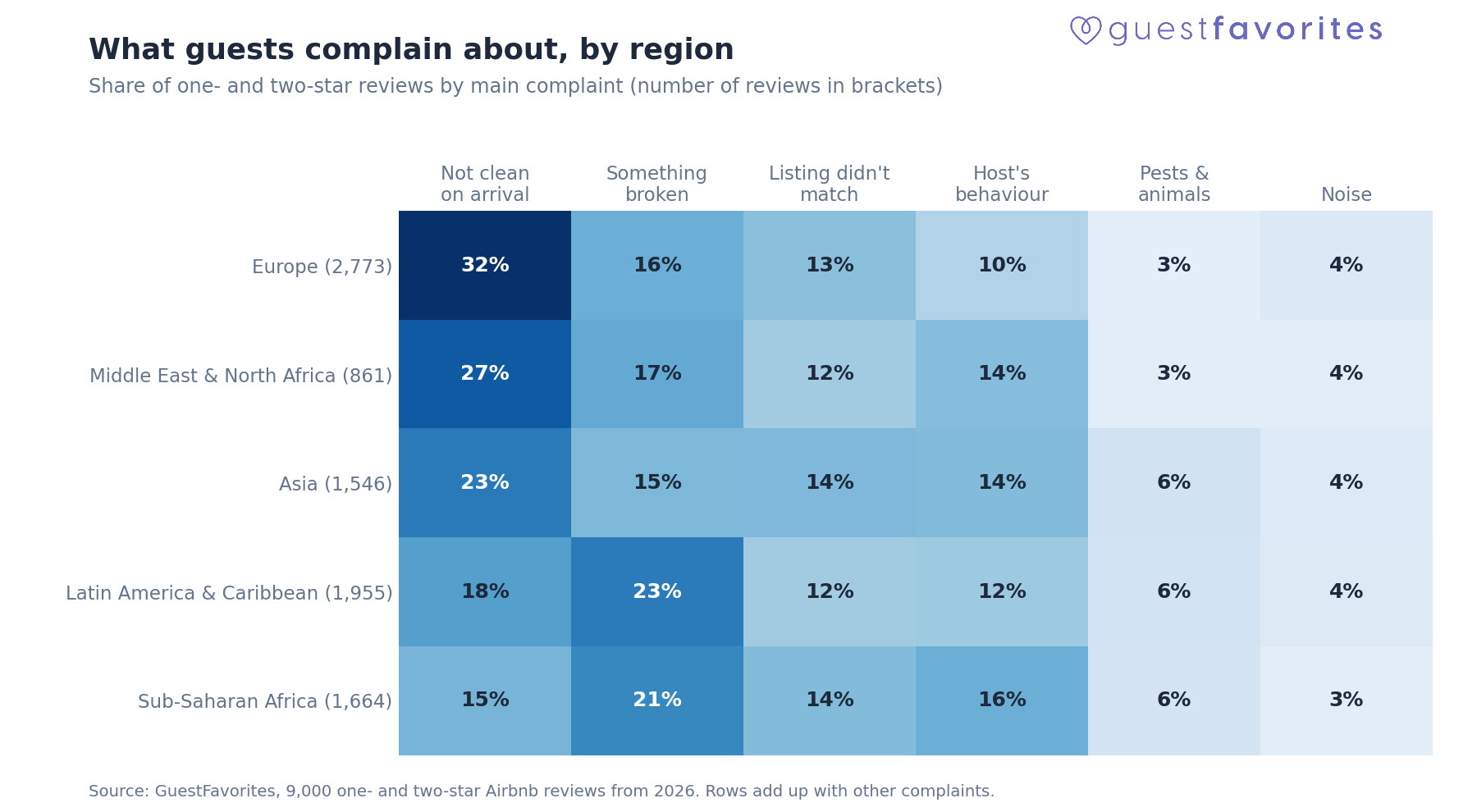
9,000 one- and two-star reviews from 2026. North America and Oceania are left out: our sample gives them fewer than 300 reviews each. Source: GuestFavorites.
Chores are almost absent. From November 20, 2026, Airbnb’s new house rules stop hosts asking guests to wash dishes, strip beds or take out the trash before they leave. In our 10,000 bad reviews, fewer than 1% were mainly about house rules or chores. A few mention checkout tasks, like the guest in Saint Lucia asked to strip the beds although it wasn’t in the listing. Guests complain about the cleaning they find, not the cleaning they’re asked to do. To see what hosts charge for cleaning, read our Airbnb cleaning fees by city report.
Where guests are hardest to please
Bad reviews are not equally rare everywhere. Among the 88 countries with at least 20,000 Airbnb reviews in 2026, the share of one- and two-star reviews is highest in the United Arab Emirates (3.6%) and Saudi Arabia (3.1%), followed by Pakistan, Malaysia and India. It is lowest in Finland (0.37%), New Zealand and Norway (0.38%), with Slovenia, Sweden, Ireland, Iceland and the British nations close behind.
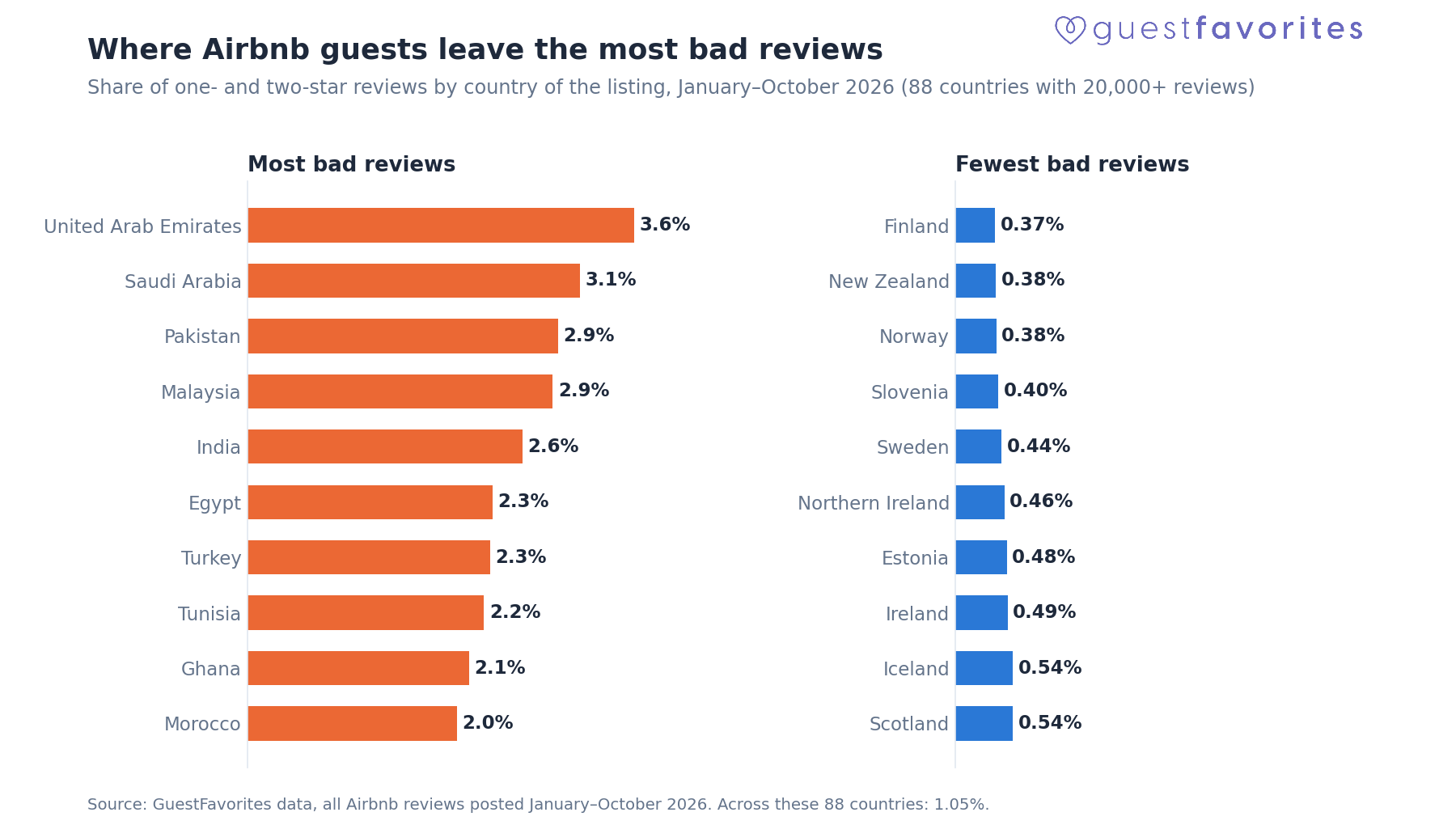
Share of one- and two-star reviews by the listing’s country, January–October 2026, countries with at least 20,000 reviews. Source: GuestFavorites.
Among the ten largest markets, Spain stands out: 1.5% of its reviews are one or two stars, and only 82% are five stars, the lowest five-star share of the ten. In the United States, 91% of reviews are five stars. The highest five-star share of any country with 20,000 reviews is South Korea’s, 92%.
How we did it
We picked 10,000 reviews rated one or two stars, posted on Airbnb in 2026, at random from GuestFavorites’ review data. Each country got a quota that favours the ones with fewer listings, so the sample covers 191 countries, from Bhutan to the Faroe Islands, instead of a handful of large markets. We read each review in full, in its original language or Airbnb’s English translation, and filed it under one main complaint. Every story above was checked against the review it comes from. We retold them in our own words, left out names, buildings and towns, and skipped stories about safety, health, crime, harassment or discrimination, however strange.
The rating shares, overall and by country, come from all 63.3 million Airbnb reviews posted from January to October 2026 in GuestFavorites data, counted by the listing’s country.
FAQ
How common are one-star Airbnb reviews?
Rare. Of the 63.3 million Airbnb reviews posted worldwide from January to October 2026, in GuestFavorites data, 0.53% gave one star and 0.53% two stars: about one review in 95. Five stars account for 88%.
Which countries have the most bad Airbnb reviews?
In 2026, the United Arab Emirates (3.6%), Saudi Arabia (3.1%), Pakistan and Malaysia (2.9%) had the highest share of one- and two-star Airbnb reviews among countries with at least 20,000 reviews, in GuestFavorites data. Finland (0.37%), New Zealand and Norway (0.38%) had the lowest. Worldwide the share is 1.05%.
What do guests complain about most in bad Airbnb reviews?
Cleanliness. In 10,000 one- and two-star reviews from 2026, about a quarter (24%) were mainly about a home that wasn’t clean on arrival, and 18% about something broken. A listing that didn’t match the stay and the host’s behaviour came next, at 13% each. Only 79 of the 10,000 were mainly about house rules or chores.
Do guests complain about checkout chores in their reviews?
Rarely. In 10,000 one- and two-star reviews from 2026, fewer than 1% were mainly about house rules or chores, and fewer than 100 mention being asked to clean up before leaving, such as stripping the beds or running the dishwasher on the last night. Guests complain far more about the cleaning they find when they arrive.
About the author

Gabriel Schammah
Gabriel Schammah is the founder and CEO of GuestFavorites, a platform that helps vacation rental owners and managers optimize revenue with Airbnb market data.
Get GuestFavorites updates
Notes on Airbnb markets, regulation, and revenue for hosts and managers.
Related posts

Airbnb Cleaning Fees in 2026: What US Hosts Charge by City
What US Airbnb hosts charge for cleaning in October 2026, a month before Airbnb’s new house rules stop them asking guests to do dishes, strip beds or take out the trash: the median fee, its share of a short stay, the 25 largest markets, and how much more large operators charge.

Best UK Holiday Let Markets in 2026: Occupancy and Revenue
A ranking of UK holiday let markets on Airbnb data from October 2025 to September 2026: 199 local authority areas in England, Scotland, Wales and Northern Ireland, scored on revenue, occupancy, low-season demand and new supply, with the rules that apply in each nation.
Atlanta Dropped Its Limit on Airbnb Hosts. Here's Who Actually Owns the Listings
Atlanta City Council removed the rule limiting hosts to their home plus one other property, so the city can finally enforce its 2021 short-term rental law in January 2027. We looked at who owns Atlanta’s 6,134 active listings, how many show a license, and where they are.